
Corporate Real Estate Valuation: How Fair Value Strengthens Governance and Strategic Decision-Making
In today's increasingly competitive business environment, the quality of asset information has become a strategic differentiator for organizations seeking sustainable growth. Among the various assets that comprise a company's balance sheet, real estate properties often represent a substantial portion of its economic value, particularly in industries, universities, hospitals, logistics centers, retail chains, investment funds, real estate holdings, and publicly traded corporations.
Despite their significance, many organizations continue to record land, buildings, warehouses, and operational facilities at historical acquisition costs that no longer reflect market reality. In numerous cases, properties acquired decades ago remain registered at their original purchase values, creating distortions that may impact financial analysis, business negotiations, financing operations, and audit procedures.
For this reason, periodic real estate valuation has become a critical practice for companies committed to Corporate Governance, Compliance, Risk Management, and Asset Management best practices.
Understanding Fair Value
Fair Value represents the estimated price at which an asset could be exchanged between knowledgeable, willing, and independent parties in an arm's-length transaction under normal market conditions.
Under International Financial Reporting Standards (IFRS), Fair Value measurement plays a fundamental role in financial reporting and asset disclosure. Accurate property valuation provides investors, auditors, boards of directors, financial institutions, and stakeholders with information that more closely reflects the organization's actual economic position.
As businesses increasingly seek transparency and accountability, Fair Value assessments have become an essential component of corporate asset management strategies.
Why Should Companies Periodically Revalue Their Properties?
Real estate values are constantly influenced by economic and market dynamics, including:
-
Urban expansion;
-
Infrastructure investments;
-
Population growth;
-
Commercial development;
-
Regulatory changes;
-
Zoning modifications;
-
Regional economic growth;
-
Supply and demand fluctuations.
Likewise, certain properties may experience depreciation, functional obsolescence, or economic deterioration over time.
When these market changes are not reflected in accounting records, organizations may operate with outdated and potentially misleading information regarding their asset base.
This can directly affect:
-
Mergers and Acquisitions (M&A);
-
Business Valuation (Valuation Studies);
-
Financing and Credit Operations;
-
Corporate Restructuring;
-
Judicial Recovery Processes;
-
Insurance Coverage Reviews;
-
Tax and Compliance Assessments;
-
Investor Relations;
-
Strategic Planning.
Regular valuation reviews help ensure that management decisions are based on reliable and current information.
The Importance of the Evolutionary Method
Among the methodologies applied in corporate real estate valuation, the Evolutionary Method is one of the most relevant for specialized and operational properties.
This methodology is widely used in:
-
Industrial Facilities;
-
Manufacturing Plants;
-
Universities;
-
Hospitals;
-
Distribution Centers;
-
Logistics Warehouses;
-
Corporate Campuses.
The Evolutionary Method determines property value by separately assessing the land value and the value of improvements or buildings. The analysis considers replacement or reproduction costs and applies physical, functional, and economic depreciation factors.
This approach provides a highly reliable estimate of value, especially for assets that do not have sufficient comparable market transactions.
For corporations with complex operational facilities, the Evolutionary Method is often the preferred valuation approach for determining Fair Value.
The Real Estate Valuation Process
Professional real estate valuation requires a structured methodology aligned with recognized technical standards and international valuation practices.
1. Project Planning
The process begins with defining:
-
Valuation objectives;
-
Property portfolio scope;
-
Geographic coverage;
-
Technical assumptions;
-
Reporting requirements;
-
Project timelines.
A clear understanding of the client's objectives is essential for delivering accurate and meaningful results.
2. Document Review
The valuation team analyzes available documentation, including:
-
Property deeds;
-
Land registry records;
-
Architectural drawings;
-
Construction permits;
-
Engineering documentation;
-
Asset records;
-
Financial and accounting information.
This stage provides the foundation for the technical assessment.
3. On-Site Inspections
Field inspections are among the most critical stages of the valuation process.
Qualified professionals perform detailed site visits to identify:
-
Construction characteristics;
-
Building condition;
-
Maintenance status;
-
Architectural standards;
-
Operational functionality;
-
Building areas;
-
Infrastructure components;
-
Installed improvements.
For organizations with properties located across multiple regions or countries, conducting standardized inspections becomes a significant logistical challenge requiring specialized expertise.
4. Market Research
Following inspections, market data is collected and analyzed to support the selected valuation methodologies.
This research includes:
-
Comparable property transactions;
-
Market trends;
-
Regional economic indicators;
-
Construction cost references;
-
Rental market data.
Reliable market evidence is essential for ensuring valuation credibility.
5. Valuation Modeling
Using the collected information, valuation specialists apply the appropriate methodologies to determine:
-
Market Value;
-
Fair Value;
-
Insurance Value;
-
Liquidation Value;
-
Investment Value.
Advanced financial and statistical techniques may also be employed depending on the complexity of the assignment.
6. Valuation Report Preparation
The final deliverable is a comprehensive valuation report containing:
-
Scope of work;
-
Methodologies applied;
-
Market evidence;
-
Technical assumptions;
-
Valuation calculations;
-
Photographic documentation;
-
Conclusions and certifications.
This report serves as a valuable resource for management, auditors, investors, and regulatory authorities.
Real Estate Valuation and Corporate Governance
Strong Corporate Governance relies on transparency, accountability, and high-quality information.
Periodic property valuation supports governance initiatives by:
-
Enhancing financial reporting quality;
-
Improving asset transparency;
-
Supporting audit procedures;
-
Strengthening internal controls;
-
Reducing financial risks;
-
Increasing investor confidence;
-
Supporting strategic decision-making.
Organizations that maintain updated asset information demonstrate greater management maturity and a stronger commitment to best governance practices.
The AXS Consulting Expertise
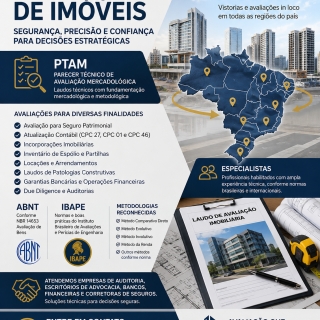
AXS Consulting specializes in delivering nationwide asset management and valuation solutions for corporations across multiple industries.
Our services include:
-
Real Estate Valuation;
-
Fixed Asset Inventory;
-
Physical-to-Accounting Reconciliation;
-
Useful Life Assessment;
-
Residual Value Studies;
-
Fair Value Determination;
-
Insurance Valuation;
-
Impairment Testing (IAS 36 / CPC 01);
-
Asset Governance Projects.
With extensive experience conducting inspections and valuation projects throughout Brazil, AXS supports industries, universities, hospitals, logistics operators, investment funds, public entities, and multinational corporations.
By combining technical expertise, field experience, and structured methodologies, AXS provides reliable information that enables executives, boards of directors, auditors, investors, and financial institutions to make informed decisions.
In a business environment where asset quality directly impacts corporate value, periodic real estate valuation is no longer merely a technical requirement—it has become a strategic management tool capable of generating transparency, supporting governance, and creating long-term value.